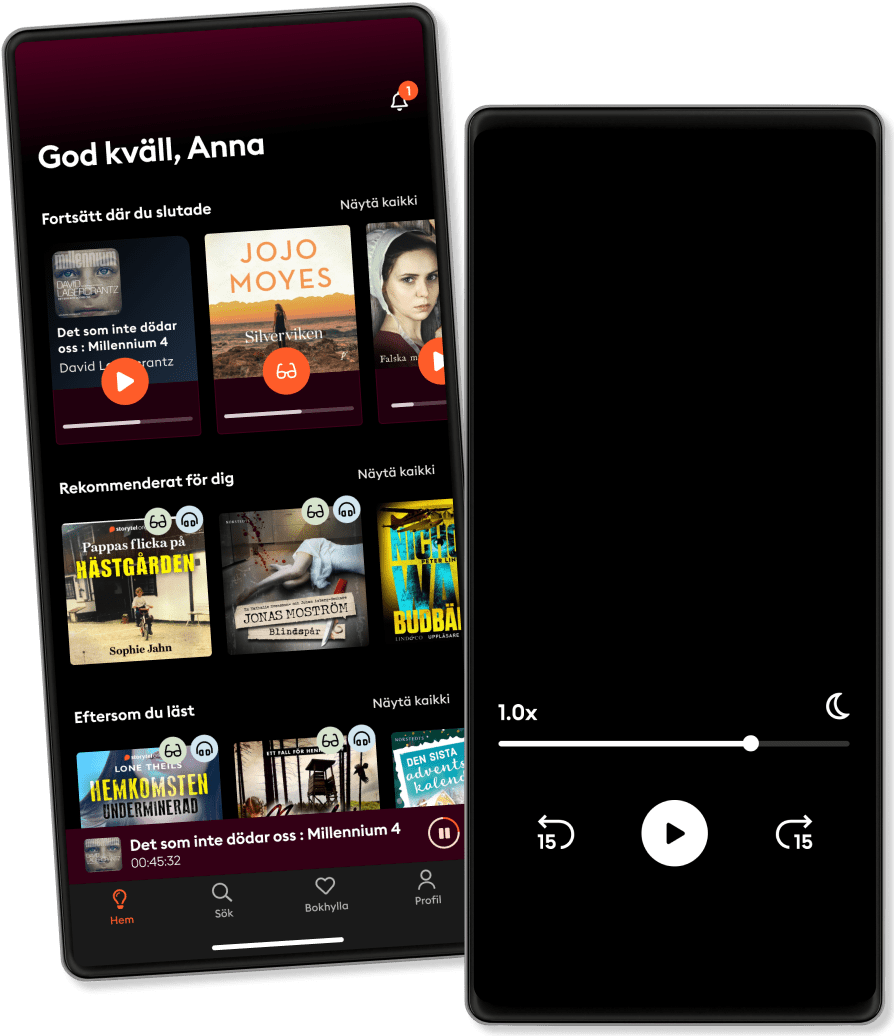
Listen and read
Step into an infinite world of stories
- Read and listen as much as you want
- Over 1 million titles
- Exclusive titles + Storytel Originals
- 7 days free trial, then €9.99/month
- Easy to cancel anytime

Once Upon an Algorithm: How Stories Explain Computing
- Author
- Narrator
- Publisher
- 17 Ratings
3.3
- Duration
- 10H 48min
- Language
- English
- Format
- Category
Non-fiction
How Hansel and Gretel, Sherlock Holmes, the movie Groundhog Day, Harry Potter, and other familiar stories illustrate the concepts of computing.
Picture a computer scientist, staring at a screen and clicking away frantically on a keyboard, hacking into a system, or perhaps developing an app. Now delete that picture. In Once Upon an Algorithm, Martin Erwig explains computation as something that takes place beyond electronic computers, and computer science as the study of systematic problem solving. Erwig points out that many daily activities involve problem solving. Getting up in the morning, for example: You get up, take a shower, get dressed, eat breakfast. This simple daily routine solves a recurring problem through a series of well-defined steps. In computer science, such a routine is called an algorithm.
Erwig illustrates a series of concepts in computing with examples from daily life and familiar stories. Hansel and Gretel, for example, execute an algorithm to get home from the forest. The movie Groundhog Day illustrates the problem of unsolvability; Sherlock Holmes manipulates data structures when solving a crime; the magic in Harry Potter's world is understood through types and abstraction; and Indiana Jones demonstrates the complexity of searching. Along the way, Erwig also discusses representations and different ways to organize data; "intractable" problems; language, syntax, and ambiguity; control structures, loops, and the halting problem; different forms of recursion; and rules for finding errors in algorithms.
This engaging book explains computation accessibly and shows its relevance to daily life. Something to think about next time we execute the algorithm of getting up in the morning.
© 2018 Tantor Media (Audiobook): 9781977383549
Release date
Audiobook: 12 June 2018
Books similar to Once Upon an Algorithm: How Stories Explain Computing
- This Idea Must Die: Scientific Theories That Are Blocking Progress John Brockman
- Computational Thinking Peter J. Denning, Matti Tedre
- The Ethical Algorithm: The Science of Socially Aware Algorithm Design Michael Kearns, Aaron Roth
- Measurement Paul Lockhart
- Fluke: The Math and Myth of Coincidence Joseph Mazur
- The Future Nick Montfort
- This Explains Everything: Deep, Beautiful, and Elegant Theories of How the World Works John Brockman
- Robot-Proof: Higher Education in the Age of Artificial Intelligence Joseph E. Aoun
- Automate This: How Algorithms Came to Rule Our World Christopher Steiner
- Artificial You: AI and the Future of Your Mind Susan Schneider
- What the Luck?: The Surprising Role of Chance in Our Everyday Lives Gary Smith
- What Should We Be Worried About?: Real Scenarios That Keep Scientists Up at Night John Brockman
- The Ethics of Influence: Government in the Age of Behavioral Science Cass R. Sunstein
- Designing the Urban Future: Smart Cities Scientific American
- Ten Short Lessons in Artificial Intelligence and Robotics Peter J. Bentley
- Lecturing Birds on Flying: Can Mathematical Theories Destroy the Financial Markets Pablo Triana
- Why?: What Makes Us Curious Mario Livio
- Uberland: How Algorithms Are Rewriting the Rules of Work Alex Rosenblat
- Climate Change: Planet under Pressure Scientific American
- Averting Catastrophe: Decision Theory for COVID-19, Climate Change, and Potential Disasters of All Kinds Cass R. Sunstein
- Doing the Right Thing: Ethics in Science Scientific American
- Mastering Logical Fallacies: The Definitive Guide to Flawless Rhetoric and Bulletproof Logic Michael Withey
- The Internet Things Samuel Greengard
- Zero: The Biography of a Dangerous Idea Charles Seife
- Maths on the Back of an Envelope: Clever ways to (roughly) calculate anything Rob Eastaway
- Artificial Intelligence: Modern Magic or Dangerous Future? Yorick Wilks
- Cognitive Gadgets: The Cultural Evolution of Thinking Cecilia Heyes
- Robot Rules: Regulating Artificial Intelligence Jacob Turner
- Radical Technologies: The Design of Everyday Life Adam Greenfield
- On Rumours: How Falsehoods Spread, Why We Believe Them, What Can Be Done Cass R. Sunstein
- Our Senses: An Immersive Experience Rob DeSalle
- Liars and Outliers: Enabling the Trust that Society Needs to Thrive Bruce Schneier
- Where Are We Heading?: The Evolution of Humans and Things Ian Hodder
- The Clock Mirage: Our Myth of Measured Time Joseph Mazur
- Future Minds: The Rise of Intelligence, from the Big Bang to the End of the Universe Richard Yonck
- Deep Learning John D. Kelleher
- Humans Need Not Apply: A Guide to Wealth and Work in the Age of Artificial Intelligence Jerry Kaplan
- Utopia Is Creepy: And Other Provocations Nicholas Carr
- Martin Gardner: The Magic and Mystery of Numbers Scientific American
- This is Not Normal: The Politics of Everyday Expectations: The Politics of Everyday Expectations Cass R. Sunstein
- The Third Wave Alvin Toffler
- Liars: Falsehoods and Free Speech in an Age of Deception: Falsehoods and Free Speech in an Age of Deception Cass R. Sunstein
- Conformity: The Power of Social Influences Cass R. Sunstein
- Understanding Beliefs Nils J. Nilsson
- Vices of the Mind: From the Intellectual to the Political Quassim Cassam
- Big Data: How the Information Revolution Is Transforming Our Lives Brian Clegg
- The Future of Energy Scientific American
- The Body Builders: Inside the Science of the Engineered Human Adam Piore
- The 48 Laws of PowerRobert Greene
- Mais esperto que o diabo: O mistério revelado da liberdade e do sucessoNapoleon Hill
- The 48 Laws of PowerRobert Greene
- Dışa Bakan Rüya Görür İçe Bakan Uyanır - Carl Gustav JungCarl Gustav Jung, Özlem Küskü
- Can’t Hurt Me - Summarized for Busy People: Master Your Mind and Defy the Odds: Based on the Book by David GogginsDavid Goggins
- Атомные привычки. Как приобрести хорошие привычки и избавиться от плохих: Простой и надежный способ избавиться от плохих привычек и завести хорошиеДжеймс Клир
- The Untethered Soul: The Journey Beyond YourselfMichael A. Singer
- Поправителен за родители: Неверните вярвания за възпитаниетоМадлен Алгафари
- İnsan OlmakEngin Geçtan
- İnsanın Anlam ArayışıViktor E. Frankl
- Philosophy of Science: A Very Short Introduction, 2nd EditionSamir Okasha
- Why Has Nobody Told Me This Before?Julie Smith
- Tanrılar OkuluStefano D'Anna
- The SecretRhonda Byrne
- AI Engineering: Building Applications with Foundation ModelsChip Huyen
- All About Love: New Visionsbell hooks
- What Every BODY is Saying: An Ex-FBI Agent’s Guide to Speed-Reading PeopleJoe Navarro, Marvin Karlins
- Ulusların DüşüşüJames Robinson, Daron Acemoğlu
- 101 Essays That Will Change The Way You ThinkBrianna Wiest
- Live More Think LessPia Callesen
- WolfLara Taveirne
- Не верь всему, что чувствуешь. Как тревога и депрессия заставляют нас поверить тому, чего нетРоберт Лихи
- Kız NeşesiBuket Uzuner
- The Handmaid's Tale by Margaret Atwood (Book Analysis): Detailed Summary, Analysis and Reading GuideBright Summaries
- Сам секс: Как обсуждать, получать и доставлять удовольствиеСаша Казанцева
This is why you’ll love Storytel
Listen and read without limits
800 000+ stories in 40 languages
Kids Mode (child-safe environment)
Cancel anytime
Unlimited
Listen and read as much as you want
9.99 € /month
1 account
Unlimited Access
Offline Mode
Kids Mode
Cancel anytime