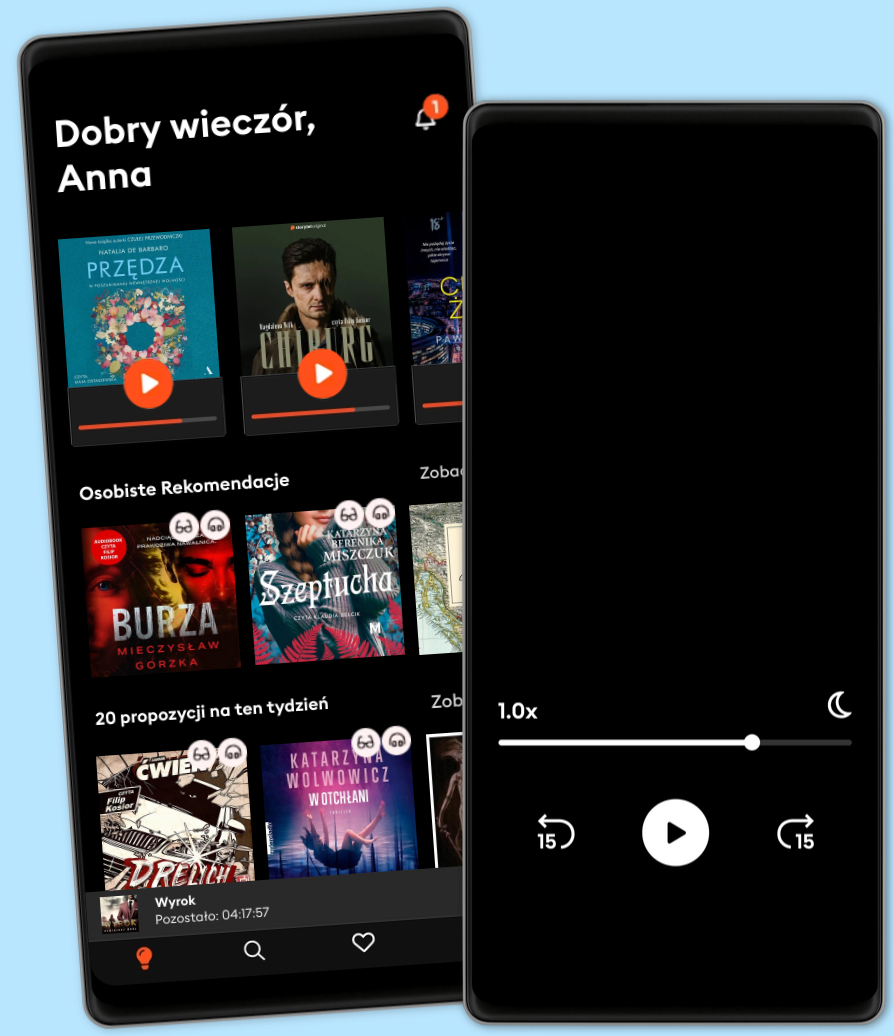
Słuchaj i czytaj 50% taniej przez 6 miesięcy!

Znajdź swoją nową ulubioną opowieść - teraz za jedyne 19,95 zł miesięcznie przez pierwsze 6 miesięcy.

  • Czytaj i słuchaj jak chcesz i ile chcesz
  • Ponad 500 000 tytułów
  • Tytuły dostępne wyłącznie w Storytel oraz Storytel Originals
  • Łatwa rezygnacja w dowolnym momencie
Skorzystaj z promocji
Cover for Free Will

Free Will

10 ocena

3.3

Czas
2 Godz. 53 min
Język
Angielski
Format
Kategoria

Literatura Faktu

The MIT Press Essential Knowledge series In our daily life, it really seems as though we have free will, that what we do from moment to moment is determined by conscious decisions that we freely make. You get up from the couch, you go for a walk, you eat chocolate ice cream. It seems that we're in control of actions like these; if we are, then we have free will. But in recent years, some have argued that free will is an illusion. The neuroscientist (and best-selling author) Sam Harris and the late Harvard psychologist Daniel Wegner, for example, claim that certain scientific findings disprove free will. In this engaging and accessible volume in the Essential Knowledge series, the philosopher Mark Balaguer examines the various arguments and experiments that have been cited to support the claim that human beings don't have free will. He finds them to be overstated and misguided.

Balaguer discusses determinism, the view that every physical event is predetermined, or completely caused by prior events. He describes several philosophical and scientific arguments against free will, including one based on Benjamin Libet's famous neuroscientific experiments, which allegedly show that our conscious decisions are caused by neural events that occur before we choose. He considers various religious and philosophical views, including the philosophical pro-free-will view known as compatibilism. Balaguer concludes that the anti-free-will arguments put forward by philosophers, psychologists, and neuroscientists simply don't work. They don't provide any good reason to doubt the existence of free will. But, he cautions, this doesn't necessarily mean that we have free will. The question of whether we have free will remains an open one; we simply don't know enough about the brain to answer it definitively.

© 2015 Ascent Audio (Audiobook): 9781469032955

Wydanie

Audiobook: 1 lipca 2015

Tagi

    Inni polubili także ...

    1. Systems Biology: A Very Short Introduction
      Systems Biology: A Very Short Introduction Eberhard O. Voit
    2. Philosophy: The Audio Masterclass: The Comprehensive Guide to Philosophy and Ethics
      Philosophy: The Audio Masterclass: The Comprehensive Guide to Philosophy and Ethics Mel Thompson, Mark Vernon, Nicky Hayes
    3. Information and Society
      Information and Society Michael Buckland
    4. Post-Truth
      Post-Truth Lee McIntyre
    5. Conscience: The Origins of Moral Intuition
      Conscience: The Origins of Moral Intuition Patricia S. Churchland
    6. An Introduction to Information Theory: Symbols, Signals and Noise
      An Introduction to Information Theory: Symbols, Signals and Noise John R. Pierce
    7. In Search of Memory: The Emergence of a New Science of Mind
      In Search of Memory: The Emergence of a New Science of Mind Eric R. Kandel
    8. The Enigma of Reason
      The Enigma of Reason Hugo Mercier, Dan Sperber
    9. Understanding Beliefs
      Understanding Beliefs Nils J. Nilsson
    10. Energy Systems: A Very Short Introduction
      Energy Systems: A Very Short Introduction Nick Jenkins
    11. Numbers: A Very Short Introduction
      Numbers: A Very Short Introduction Peter M. Higgins
    12. Cognitive Gadgets: The Cultural Evolution of Thinking
      Cognitive Gadgets: The Cultural Evolution of Thinking Cecilia Heyes
    13. Mathematics for Human Flourishing
      Mathematics for Human Flourishing Francis Su
    14. Philosophy Made Slightly Less Difficult: A Beginner's Guide to Life's Big Questions
      Philosophy Made Slightly Less Difficult: A Beginner's Guide to Life's Big Questions J. P. Moreland, Garrett J. DeWeese
    15. Number Theory: A Very Short Introduction
      Number Theory: A Very Short Introduction Robin Wilson
    16. Measurement
      Measurement Paul Lockhart
    17. Choice Theory: A Very Short Introduction
      Choice Theory: A Very Short Introduction Michael Allingham
    18. The Ethical Algorithm: The Science of Socially Aware Algorithm Design
      The Ethical Algorithm: The Science of Socially Aware Algorithm Design Michael Kearns, Aaron Roth
    19. On Freedom
      On Freedom Cass R. Sunstein
    20. Psychology: A Very Short Introduction
      Psychology: A Very Short Introduction Freda McManus, Gillian Butler
    21. The Misinformation Age: How False Beliefs Spread
      The Misinformation Age: How False Beliefs Spread Cailin O’Connor, James Owen Weatherall
    22. Logic: A Very Short Introduction
      Logic: A Very Short Introduction Graham Priest
    23. Topology: A Very Short Introduction
      Topology: A Very Short Introduction Richard Earl
    24. Mathematics: A Very Short Introduction
      Mathematics: A Very Short Introduction Timothy Gowers
    25. The Laws of Thermodynamics: A Very Short Introduction
      The Laws of Thermodynamics: A Very Short Introduction Peter Atkins
    26. Philosophy of Physics: A Very Short Introduction
      Philosophy of Physics: A Very Short Introduction David Wallace
    27. Ancient Philosophy: The Fundamentals
      Ancient Philosophy: The Fundamentals Daniel W. Graham
    28. The Bourgeois Virtues: Ethics for an Age of Commerce
      The Bourgeois Virtues: Ethics for an Age of Commerce Deirdre N. McCloskey
    29. Spatial Computing
      Spatial Computing Pamela Vold, Shashi Shekhar
    30. Becoming Human: A Theory of Ontogeny
      Becoming Human: A Theory of Ontogeny Michael Tomasello
    31. Life: The Leading Edge of Evolutionary Biology, Genetics, Anthropology, and Environmental Science
      Life: The Leading Edge of Evolutionary Biology, Genetics, Anthropology, and Environmental Science John Brockman
    32. On the Origin of Evolution: Tracing ‘Darwin’s Dangerous Idea’ from Aristotle to DNA
      On the Origin of Evolution: Tracing ‘Darwin’s Dangerous Idea’ from Aristotle to DNA John Gribbin, Mary Gribbin
    33. The Logic of Scientific Discovery
      The Logic of Scientific Discovery Karl Popper
    34. Intelligence: A Very Short Introduction, 2nd edition
      Intelligence: A Very Short Introduction, 2nd edition Ian J. Deary
    35. Biochemistry: A Very Short Introduction
      Biochemistry: A Very Short Introduction Mark Lorch
    36. The Secret Life of Science: How It Really Works and Why It Matters
      The Secret Life of Science: How It Really Works and Why It Matters Jeremy J. Baumberg
    37. Vices of the Mind: From the Intellectual to the Political
      Vices of the Mind: From the Intellectual to the Political Quassim Cassam
    38. What Should We Be Worried About?: Real Scenarios That Keep Scientists Up at Night
      What Should We Be Worried About?: Real Scenarios That Keep Scientists Up at Night John Brockman
    39. Nihilism
      Nihilism Nolen Gertz
    40. The Technological Singularity
      The Technological Singularity Murray Shanahan
    41. Human Evolution: A Very Short Introduction
      Human Evolution: A Very Short Introduction Bernard Wood
    42. Physics for Poets
      Physics for Poets Richard T. Kouzes
    43. A Brief History of 20th Century Western Philosophy
      A Brief History of 20th Century Western Philosophy Garrett Thomson
    44. Genomics: A Very Short Introduction
      Genomics: A Very Short Introduction John M. Archibald
    45. The Shape of a Life: One Mathematician’s Search for the Universe’s Hidden Geometry
      The Shape of a Life: One Mathematician’s Search for the Universe’s Hidden Geometry Shing-Tung Yau, Steve Nadis
    46. The Serengeti Rules: The Quest to Discover How Life Works and Why It Matters
      The Serengeti Rules: The Quest to Discover How Life Works and Why It Matters Sean B. Carroll
    47. Metadata
      Metadata Jeffrey Pomerantz
    48. The Myth of the Framework: In Defence of Science and Rationality
      The Myth of the Framework: In Defence of Science and Rationality Karl Popper
    49. Particle Physics for Non-Physicists: A Tour of the Microcosmos
      Particle Physics for Non-Physicists: A Tour of the Microcosmos The Great Courses, Steven Pollock

    Wybierz swoją subskrypcję:

    • Ponad 500 000 tytułów w cenie jednego abonamentu

    • Słuchaj i czytaj w trybie offline

    • Ekskluzywne produkcje audio Storytel Original

    • Tryb dziecięcy Kids Mode

    • Anuluj kiedy chcesz

    Unlimited na rok

    Dla tych, którzy chcą słuchać i czytać bez limitów.

    39.90 zł /30 dni

    • 1 konto

    • Nieograniczony Dostęp

    • Słuchanie bez limitów

    • Anuluj w dowolnym momencie

    Rozpocznij subskrypcję

    Family

    Dla tych, którzy chcą dzielić się historiami ze znajomymi i rodziną.

    Od 59.90 zł /30 dni

    • 2-3 konta

    • Nieograniczony Dostęp

    • Słuchanie bez limitów

    • Anuluj w dowolnym momencie

    Ty + 1 członek rodziny

    2 konta

    59.90 zł /30 dni

    Wypróbuj
    Najpopularniejsze

    Unlimited

    Dla tych, którzy chcą słuchać i czytać bez limitów.

    39.90 zł /30 dni

    • 1 konto

    • Nieograniczony Dostęp

    • Słuchanie bez limitów

    • Anuluj w dowolnym momencie

    Skorzystaj z promocji

    Basic

    Dla tych, którzy słuchają i czytają od czasu do czasu.

    22.90 zł /30 dni

    • 1 konto

    • 10 godzin/miesięcznie

    • Anuluj w dowolnym momencie

    Wypróbuj