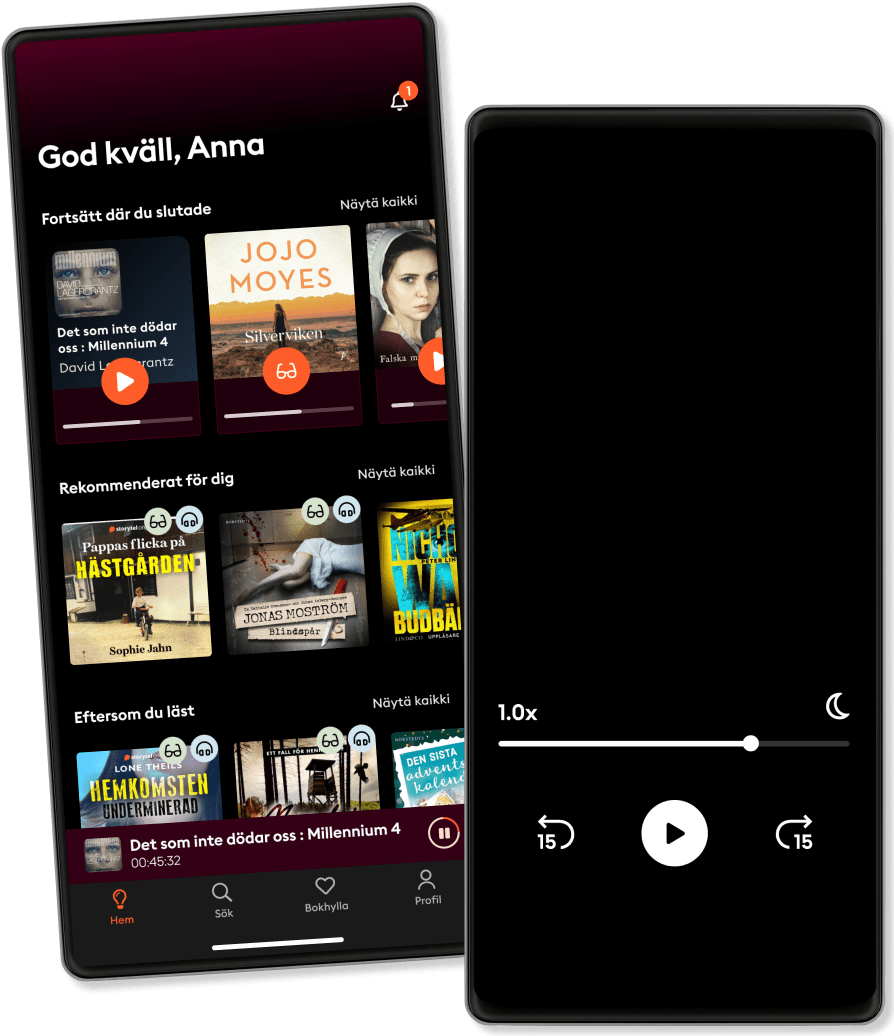
Listen and read

Step into an infinite world of stories

  • Listen and read as much as you want
  • Over 400 000+ titles
  • Bestsellers in 10+ Indian languages
  • Exclusive titles + Storytel Originals
  • Easy to cancel anytime
Subscribe now
Cover for Free Will

Free Will

10 Ratings

3.3

Duration
2H 53min
Language
English
Format
Category

Non-Fiction

The MIT Press Essential Knowledge series In our daily life, it really seems as though we have free will, that what we do from moment to moment is determined by conscious decisions that we freely make. You get up from the couch, you go for a walk, you eat chocolate ice cream. It seems that we're in control of actions like these; if we are, then we have free will. But in recent years, some have argued that free will is an illusion. The neuroscientist (and best-selling author) Sam Harris and the late Harvard psychologist Daniel Wegner, for example, claim that certain scientific findings disprove free will. In this engaging and accessible volume in the Essential Knowledge series, the philosopher Mark Balaguer examines the various arguments and experiments that have been cited to support the claim that human beings don't have free will. He finds them to be overstated and misguided.

Balaguer discusses determinism, the view that every physical event is predetermined, or completely caused by prior events. He describes several philosophical and scientific arguments against free will, including one based on Benjamin Libet's famous neuroscientific experiments, which allegedly show that our conscious decisions are caused by neural events that occur before we choose. He considers various religious and philosophical views, including the philosophical pro-free-will view known as compatibilism. Balaguer concludes that the anti-free-will arguments put forward by philosophers, psychologists, and neuroscientists simply don't work. They don't provide any good reason to doubt the existence of free will. But, he cautions, this doesn't necessarily mean that we have free will. The question of whether we have free will remains an open one; we simply don't know enough about the brain to answer it definitively.

© 2015 Ascent Audio (Audiobook): 9781469032955

Release date

Audiobook: 1 July 2015

Others also enjoyed ...

  1. Philosophy: The Audio Masterclass: The Comprehensive Guide to Philosophy and Ethics
    Philosophy: The Audio Masterclass: The Comprehensive Guide to Philosophy and Ethics Mel Thompson, Mark Vernon, Nicky Hayes
  2. Systems Biology: A Very Short Introduction
    Systems Biology: A Very Short Introduction Eberhard O. Voit
  3. Post-Truth
    Post-Truth Lee McIntyre
  4. Fractals: A Very Short Introduction
    Fractals: A Very Short Introduction Kenneth Falconer
  5. Cryptography: A Very Short Introduction
    Cryptography: A Very Short Introduction Sean Murphy, Fred Piper
  6. Design: A Very Short Introduction
    Design: A Very Short Introduction John Heskett
  7. Information and Society
    Information and Society Michael Buckland
  8. The History of Life: A Very Short Introduction
    The History of Life: A Very Short Introduction Michael J. Benton
  9. Touching a Nerve: The Self As Brain
    Touching a Nerve: The Self As Brain Patricia S. Churchland
  10. Life: The Leading Edge of Evolutionary Biology, Genetics, Anthropology, and Environmental Science
    Life: The Leading Edge of Evolutionary Biology, Genetics, Anthropology, and Environmental Science John Brockman
  11. Quantum Theory: A Very Short Introduction
    Quantum Theory: A Very Short Introduction John Polkinghorne
  12. Energy Systems: A Very Short Introduction
    Energy Systems: A Very Short Introduction Nick Jenkins
  13. Particle Physics for Non-Physicists: A Tour of the Microcosmos
    Particle Physics for Non-Physicists: A Tour of the Microcosmos The Great Courses, Steven Pollock
  14. Philosophy of Physics: A Very Short Introduction
    Philosophy of Physics: A Very Short Introduction David Wallace
  15. Physics: A Very Short Introduction
    Physics: A Very Short Introduction Sidney Perkowitz
  16. Mathematics: A Very Short Introduction
    Mathematics: A Very Short Introduction Timothy Gowers
  17. Music: A Very Short Introduction
    Music: A Very Short Introduction Nicholas Cook
  18. 12 Essential Scientific Concepts
    12 Essential Scientific Concepts The Great Courses, Indre Viskontas
  19. Logic: A Very Short Introduction
    Logic: A Very Short Introduction Graham Priest
  20. The History of Time: A Very Short Introduction
    The History of Time: A Very Short Introduction Leofranc Holford-Strevens
  21. Seven Types of Atheism
    Seven Types of Atheism John Gray
  22. Numbers: A Very Short Introduction
    Numbers: A Very Short Introduction Peter M. Higgins
  23. Roots of Human Behavior
    Roots of Human Behavior Barbara J. King, The Great Courses
  24. Choice Theory: A Very Short Introduction
    Choice Theory: A Very Short Introduction Michael Allingham
  25. A Short History of Philosophy: From Ancient Greece to the Post-Modernist Era
    A Short History of Philosophy: From Ancient Greece to the Post-Modernist Era Peter Gibson
  26. Smell: A Very Short Introduction
    Smell: A Very Short Introduction Matthew Cobb
  27. Psychology: A Very Short Introduction
    Psychology: A Very Short Introduction Freda McManus, Gillian Butler
  28. Mathematics for Human Flourishing
    Mathematics for Human Flourishing Francis Su
  29. Intelligence: A Very Short Introduction, 2nd edition
    Intelligence: A Very Short Introduction, 2nd edition Ian J. Deary
  30. The Periodic Table A Very Short Introduction, 2nd Edition: A Very Short Introduction
    The Periodic Table A Very Short Introduction, 2nd Edition: A Very Short Introduction Eric R. Scerri
  31. In Search of Memory: The Emergence of a New Science of Mind
    In Search of Memory: The Emergence of a New Science of Mind Eric R. Kandel
  32. The Higgs Boson and Beyond
    The Higgs Boson and Beyond Sean Carroll, The Great Courses
  33. Physics for Poets
    Physics for Poets Richard T. Kouzes
  34. Theory of Evolution: A History of Controversy
    Theory of Evolution: A History of Controversy Edward J. Larson, The Great Courses
  35. Great Scientific Ideas That Changed the World
    Great Scientific Ideas That Changed the World The Great Courses, Steven L. Goldman
  36. Theology: A Very Short Introduction
    Theology: A Very Short Introduction David Ford
  37. Management: A Very Short Introduction
    Management: A Very Short Introduction John Hendry
  38. The Serengeti Rules: The Quest to Discover How Life Works and Why It Matters
    The Serengeti Rules: The Quest to Discover How Life Works and Why It Matters Sean B. Carroll
  39. Theories of Human Development
    Theories of Human Development The Great Courses, Malcolm W. Watson
  40. Ethics: A History of Moral Thought
    Ethics: A History of Moral Thought Peter Kreeft
  41. Quest for Meaning: Values, Ethics, and the Modern Experience
    Quest for Meaning: Values, Ethics, and the Modern Experience The Great Courses, Robert H. Kane
  42. Conscience: The Origins of Moral Intuition
    Conscience: The Origins of Moral Intuition Patricia S. Churchland
  43. The Logic of Scientific Discovery
    The Logic of Scientific Discovery Karl Popper
  44. Anthropology and the Study of Humanity
    Anthropology and the Study of Humanity The Great Courses, Scott M. Lacy
  45. Entrepreneurship: A Very Short Introduction
    Entrepreneurship: A Very Short Introduction Paul Westhead, Mike Wright
  46. The Joy of Science
    The Joy of Science Robert M. Hazen, The Great Courses
  47. Calculating the Cosmos: How Mathematics Unveils the Universe
    Calculating the Cosmos: How Mathematics Unveils the Universe Ian Stewart